Pollokshields began as a planned suburb on the Stirling-Maxwell family's Pollok estate. Building started in 1851, and much of the Victorian layout survives. Today it is a conservation area and home to large Muslim, Sikh and Christian communities.
The story has two halves. West Pollokshields was laid out for villas in gardens. East Pollokshields grew as a grid of sandstone tenements with shops, schools and churches. Shields Road runs between them.
At a glance
- Landowners
- The Stirling-Maxwells of Pollok, linked with the lands since 1270
- Planned
- 1849, by Edinburgh architect David Rhind for Sir John Maxwell, 8th baronet
- Building began
- 1851
- Burghs
- West Pollokshields 1876; East Pollokshields 1880
- Joined Glasgow
- 1891, under the City of Glasgow Act
- Conservation areas
- East and West, both designated in 1973
- Earliest surviving villa
- The Knowe, 301 Albert Drive, by Alexander "Greek" Thomson, begun about 1852
- Name
- Gaelic Buthan Phollaig; Scots Powkshiels
- Population
- About 8,842 in Pollokshields East and 7,297 in Pollokshields West (2022 Census neighbourhood profiles)
Timeline
Dates come from the sources listed at the foot of the page. Where sources disagree, both dates are given.
The Pollok estate

- 1270The Stirling-Maxwell family's association with the lands begins. They held the Pollok estate for nearly 700 years.
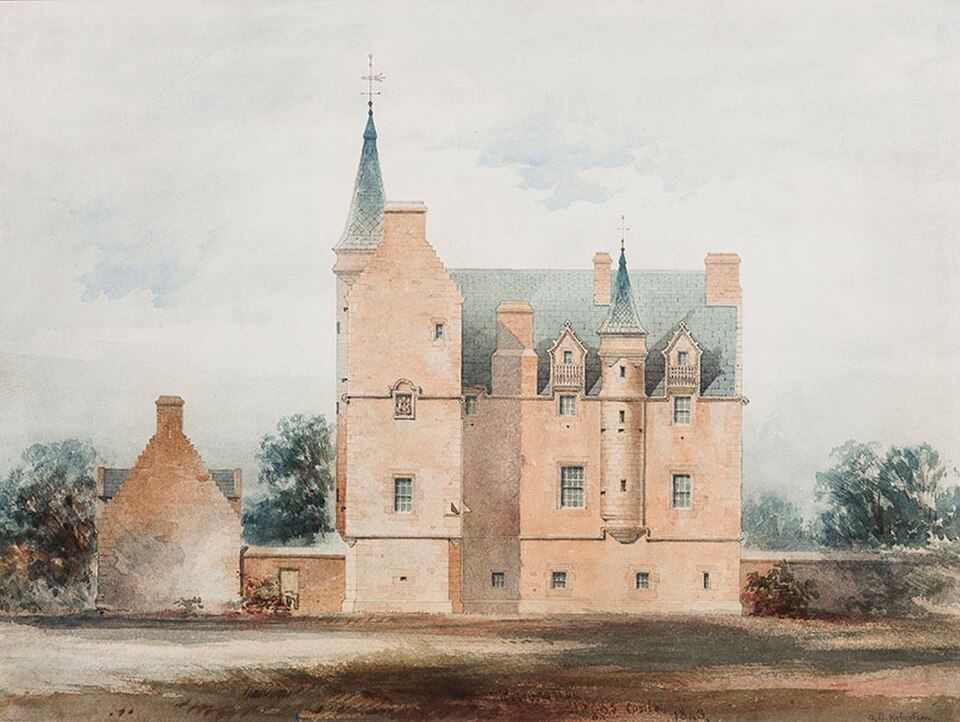
- 1585Sir John Maxwell of Pollok and his wife Margaret Conyngham build Haggs Castle to replace the older Laigh Castle. A carved stone over the door records the date.
- Later 1600sHaggs serves as a dower house. The Covenanting Maxwells are fined for nonconformity, but the 1688 Revolution spares them from paying.
- 1752Pollok House is built. It was once credited to William Adam, who may only have been consulted. The family leaves Haggs as a home when the house is finished in 1753.
- Early 1800sThe land behind today's Tramway is a commercial nursery, growing trees for large estates such as Pollok.
- 1840Pollokshields station opens on the Glasgow and Paisley Joint Railway, according to 20th-century sources. The date may be later, possibly the 1870s.
Building the suburb
- 1849Sir John Maxwell, 8th baronet (1791-1865), commissions David Rhind (1801-1883) to plan the Shields part of the estate as a middle-class suburb. Shields Road divides the villa-only west from the terraces and tenements of the east.
- About 1850The ground that becomes Maxwell Park is still farmland.
- 1850s-60sThe ruins of Haggs Castle are consolidated, then restored as a home for the estate factor.
- 1851Building begins. Baker and grain merchant Thomas Hamilton moves his family into Primrose Villa on St Andrews Drive, among the very first households. Thomson designs four villas on St Andrews Drive, all since demolished.
- About 1852Thomson's The Knowe, 301 Albert Drive, is begun for merchant John Blair in what is still open country. It is built in stages up to about 1880. Sources date its start between 1850 and 1855.
- 1855-1910The main period of building in East Pollokshields: upmarket tenement flats on a grid, with tightly controlled ground-floor shops.
- 1871Thomson designs Ellisland and Castlehill, 200 and 202 Nithsdale Road.
- 1873St Ninian's Scottish Episcopal Church is built in early French Gothic style. Thomson designs 84-112 Nithsdale Road.
- 1873 or 1876Clydesdale Cricket Club moves from Kinning Park to Titwood, selling its old ground to Rangers. Sources differ on the year; 1876 is the more specific.
- 1874Clydesdale's football side loses to Queen's Park in the first Scottish Cup final.
- 1875-79W.G. Rowan of McKissack and Rowan builds Pollokshields Free Church at 614-620 Shields Road, in the manner of Thomson.
Two burghs
- 1876West Pollokshields becomes an independent police burgh, partly to avoid Glasgow's rates.
- 27 Feb 1877The North British Daily Mail reports that East Pollokshields was farmland, hedges and lanes about six years earlier. Shops have opened only on St Andrew's Street and part of Shields Road.
- 1 Dec 1877Strathbungo station opens on the Barrhead and Kilmarnock line at the area's eastern edge.
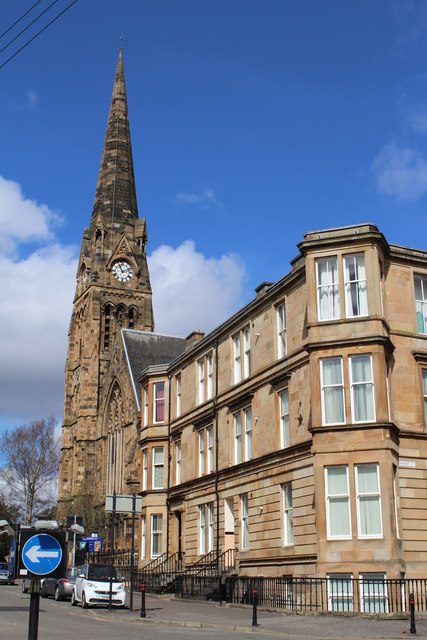
- 1877-78Robert Baldie's Pollokshields Parish Church is built on Albert Drive, with a 180 ft spire. The local heritage society dates the design to 1875.
- 1878-1888Pollokshields F.C. (renamed St Andrew's in 1885) plays in the Scottish Cup, losing 4-0 to Queen's Park in 1884-85. It folds by 1888.
- 1880East Pollokshields becomes a burgh too.
- 1881The West has 2,104 people and the East 4,360, though the West covers more than twice the area.
- 21 Mar 1882A playground shelter at the new Albert Drive school collapses onto about 30 children, and four die.
- 1882David Barclay of H and D Barclay completes the school at 241 Albert Drive, now Pollokshields Primary.
- 1883-84Queen's Park plays at Titwood while the second Hampden is finished, beating Aston Villa 6-1 there in the FA Cup.
- 1885Shields station opens on the Paisley Canal line at Shields Junction. It closes on 14 February 1966.
- 1 Mar 1886The Cathcart District Railway opens from Central, with Pollokshields East station.
- 1886 or 1887John Bennie Wilson's Stockwell Free Church at 153 Albert Drive. He won the job in competition in 1886.
- 1887Bartholomew's Gazetteer describes the police burgh as almost entirely villas, with 2,104 people, in Govan parish.
- 1887 or 1888Sir John Stirling-Maxwell gives Maxwell Park to the burgh. Sources differ on the year of the gift.
- 1889Clydesdale RFC begins playing rugby at Titwood.
- 1890H.E. Clifford's Pollokshields Burgh Hall opens in Maxwell Park, along with the park itself. The memorial stone is laid on 25 October 1890. One source says the hall was completed in 1893.
- 1891Both burghs accept favourable tax terms and join Glasgow under the City of Glasgow Act 1891. The Burgh Hall passes to the city after barely a year as burgh headquarters.
Part of Glasgow
- 1892James Miller sets up his own practice and builds Ardtornish, 30 Sutherland Avenue. W.J. Anderson builds the Gilmour and Aitken sawmill on Darnley Street.
- 1894Sherbrooke St Gilbert's Church on Nithsdale Road is built; its hall is finished in 1894 and the church in 1900.
- 2 Apr 1894The Cathcart Circle is completed via Shawlands. Pollokshields West and Maxwell Park stations open.
- 1894-1912Engineer William Clark builds the Coplawhill tram depot and works, now Tramway, in stages.
- 1895Burnet, Boston and Carruthers build terraced houses at Glencairn Drive and Shields Road. Thomson and Sandilands design Rhuadsgeir, now the Sherbrooke Castle Hotel (dated 1895 or 1896).
- About 1895Thomas Donald's Glasgow Laundry and Carpet Beating Works rises at 100-132 Albert Drive.
- 14 Dec 1896Shields Road subway station opens with the Glasgow underground. It actually sits on Scotland Street.
- 1899-1900Sir John Stirling-Maxwell restores and extends Haggs Castle. A.H. Crawford modernises Pollok House's interior.
- 1901Glasgow's trams are electrified. Tramway's horse stables give way to building and repairing electric cars.
- 1902J.C. McKellar's Oaklands villa on Sherbrooke Avenue. Gordon and Dobson's Millar and Lang art publishers' building on Darnley Street, completed by 1903.
- 1903Matheran, 27-29 Sherbrooke Avenue, is built for marine engineer Hugh Dunsmuir by Burnet, Boston and Carruthers.
- 1904The Titwood pitch moves west and a new pavilion is built.
- 20 Feb 1907Sir John Stirling Maxwell opens Pollokshields Library on Leslie Street.
- 1908The Hamilton sisters give Maxwell Park's Hamilton Fountain in memory of their brothers. The gift takes effect in 1927.
- 1911Sir John Stirling-Maxwell (1866-1956) opens the Pollok Estate to Glaswegians.
- 1912-14The parish church chancel is remodelled, with H.E. Clifford creating it. A new Harrison and Harrison organ follows in 1913.
- 1917-1919Pollokshields East station closes as a wartime economy, reopening on 1 June 1919.
- 1 Apr 1925Pollokshields, Shields and Shields Road stations merge into a single Shields Road station.
- 1929Sherbrooke church joins the Church of Scotland.
- 1931Sir John Stirling-Maxwell is a founder member of the National Trust for Scotland, and its president from 1943.
- 1935Thomas Somers extends the rear of the Burgh Hall, removing its last gallery. One source gives 1938.
- 1943Haggs Castle is requisitioned by the military. It is later divided into flats.
Change and renewal
- 1940s-50sThe first generation of South Asian migrants arrives after Partition.
- 1960sSeven brutalist eight-storey blocks are built on St Andrew's Drive, west of Shields Road.
- 28 May 1962The Cathcart Circle is electrified. Strathbungo station closes the same day.
- 1964The tram works becomes the Museum of Transport. Three of its street arches are bricked up.
- 1965-67The Archdiocese of Glasgow buys a former Presbyterian church on Albert Drive, which reopens as St Albert's in 1967.
- 1966Dame Anne Maxwell Macdonald gives Pollok House, its art and part of the estate to the city. The land later houses the Burrell Collection.
- 1972-1998Haggs Castle is Glasgow's Museum of Childhood, then becomes a private home again.
- 1973East and West Pollokshields are designated conservation areas. The East boundary is amended in 1984.
- 1975Strathclyde Region uses the Burgh Hall as a social work day centre.
- April 1976Fire badly damages the Pollokshields East station building, which British Rail rebuilds.
- 1979Masjid Noor at 79 Forth Street begins use as a mosque. The Argyle Line opens on 5 November, bringing more frequent Cathcart Circle trains.
- 1982-1986Plans to sell the Burgh Hall prompt protest. A charitable trust forms and buys it for one pound in 1986; title follows in 1991.
- 1987Clydesdale buys Titwood from the Pollok Estate for 29,000 pounds. The Museum of Transport moves to Kelvin Hall.
- 1988Tramway opens as an arts venue with Peter Brook's nine-hour The Mahabharata.
- 1989Pollokshields Development Agency is set up as a community charity. Sheila Ogilvie publishes Pollokshields Pastiche.
- 1990Tramway is Category B listed on 26 February.
- 1992Pollokshields Heritage, the local conservation and amenity society, is founded.
- 1993The Burgh Hall is upgraded from Category B to Category A on 13 May.
- 1994Sherbrooke St Gilbert's Church is rebuilt after a major fire.
- About 1997The Burgh Hall lodge and ground floor are refurbished.
- 1998-2000Zoo Architects redevelop Tramway.
The 21st century
- 21 Jun 2003The Hidden Gardens open behind Tramway, made by the arts group NVA after 18 months of community consultation. Plans to hand Tramway to Scottish Ballet are scaled back after opposition.
- March 2004Teenager Kriss Donald is abducted from Kenmure Street and killed in a racially motivated attack. The case produced Scotland's first conviction for racially motivated murder.
- 16 Aug 2007Titwood hosts its first One-Day International, Scotland v India.
- 2009Scottish Ballet moves into new headquarters in the rear of Tramway, by Malcolm Fraser Architects.
- 2011Matheran becomes a family home again after years as an occupational therapy school.
- 3 Mar 2013Pollokshields Heritage launches three printed trail leaflets.
- 2013The Glasgow Gurdwara opens at 37 Albert Drive, next to Tramway, on a former derelict site.
- 2015Tramway hosts the Turner Prize.
- 31 Aug 2015A 26 million pound Southside Housing Association programme starts to replace 272 substandard 1960s homes around St Andrew's Drive with 153 new homes.
- Feb 2016The "Make Your Mark" charrette for East Pollokshields and Port Eglinton draws up a design code. The Pollokshields Trust is set up to take it forward.
- March 2021Planning approval for 120 flats in 14 buildings around St Andrew's Drive, Shields Road, Maxwell Drive and St John's Road.
- 13 May 2021On Eid al-Fitr, neighbours surround a Home Office van on Kenmure Street holding two local Sikh men. After about eight hours, police release the men, who are taken to a nearby mosque.
- May 2022A "Festival of Resistance" marks the first anniversary of the Kenmure Street protest.
- Oct 2023Residents move into the new homes replacing the 1960s deck-access blocks.
- 2024After Bonfire Night disorder in 2023 and 2024, a Firework Control Zone is approved but falls through when a legal notice deadline is missed.
- May 2025A petition is lodged to wind up Pollokshields Development Agency, set up in 1989, and the charity goes into liquidation.
- June 2025Titwood hosts men's T20 internationals, including Scotland v Netherlands and Scotland v Nepal.
- 1-10 Nov 2025Glasgow's first Firework Control Zones take effect, in Pollokshields, Govanhill and Broomhouse.
- Jan 2026The documentary Everybody to Kenmure Street premieres at Sundance, with a UK release in spring 2026.
The garden suburb plan
Pollokshields was planned, not grown. In 1849 Sir John Maxwell, 8th baronet, asked Edinburgh architect David Rhind to lay out the Shields part of the Pollok estate as a suburb for the middle classes.
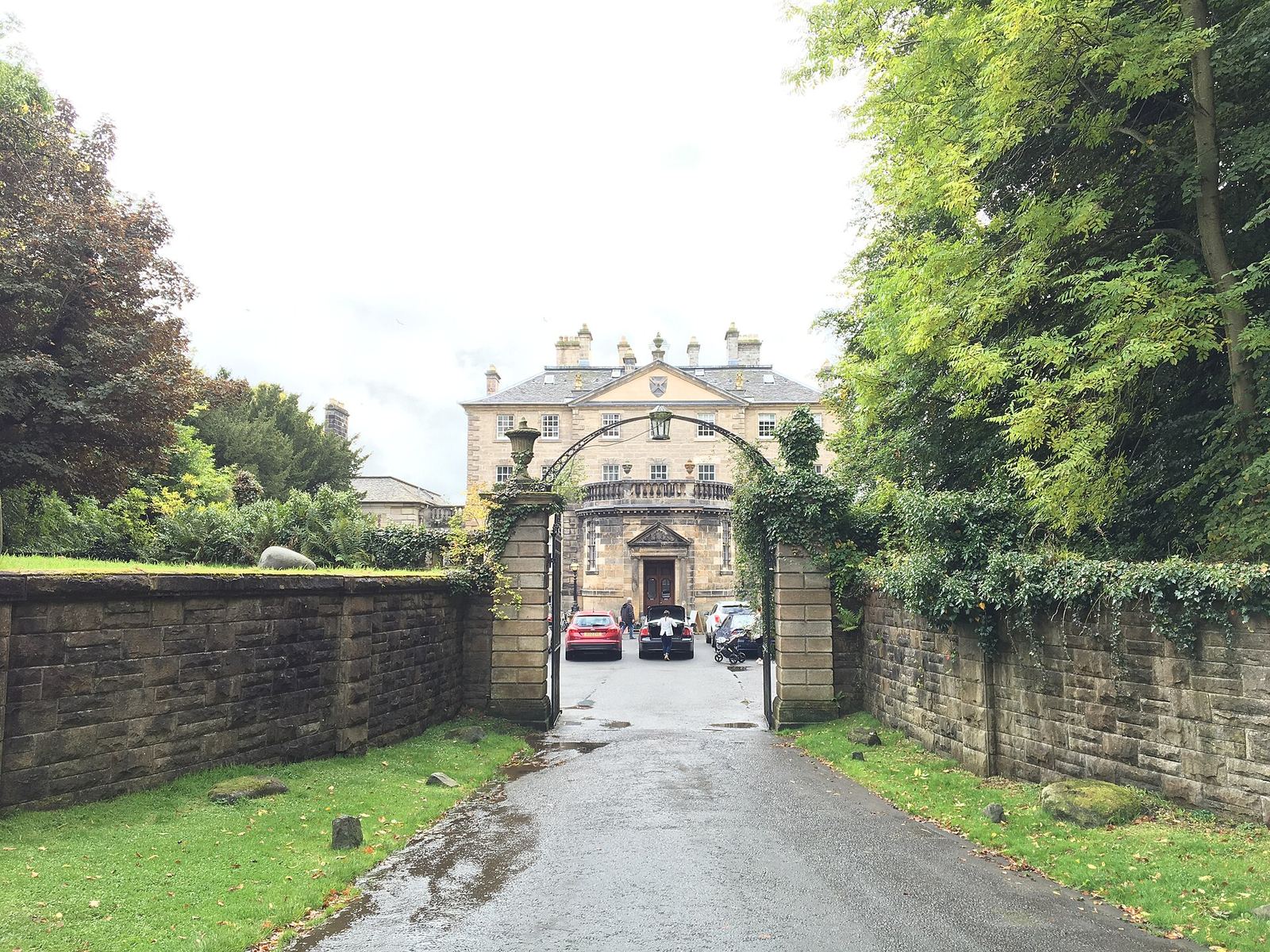

Building began in 1851. Pollokshields Heritage calls it one of Britain's first garden suburbs, and the UK's biggest and best-preserved planned garden suburb.
The family controlled what was built through feu conditions, the terms on which plots were granted. In the west these allowed villas only, with no shops. In the east, shops were permitted but tightly controlled.
Three generations of Stirling Maxwells shaped the suburb. Sir John Stirling-Maxwell, 10th baronet (1866-1956), gave Maxwell Park, opened the Burgh Hall and the library, and later opened the Pollok Estate to Glaswegians.
Sources give 1848, 1849 and 1851 for the start. The likeliest reading is that the plan dates from 1849 and building from 1851.
Two burghs
For 15 years Pollokshields ran its own affairs as two separate burghs. West Pollokshields became a police burgh in 1876, partly to avoid paying Glasgow's rates. East Pollokshields followed in 1880.
The independence did not last. In 1891 tax concessions persuaded both to join Glasgow. The new Burgh Hall had served as headquarters for barely a year.
| Feature | West Pollokshields | East Pollokshields |
|---|---|---|
| Burgh status | 1876 | 1880 |
| Population in 1881 | 2,104 | 4,360 |
| Area | More than twice the size of the East | Smaller and more densely built |
| Street pattern | Curving, tree-lined streets | A grid |
| Housing | Detached and semi-detached villas in gardens | Three-storey sandstone tenements and terraces |
| Shops | Not allowed under the feu conditions | Permitted at ground floor, tightly controlled |
| Role | Purely residential | The social hub, with shops, schools and churches |
| Main building period | From 1851 | 1855-1910 |
| Conservation area | Designated 1973; no published appraisal | Designated 1973, amended 1984, appraisal approved 2011; about 42 hectares |
| Population (2022 Census neighbourhood) | About 7,297; 39.3% minority ethnic | About 8,842; 53.5% minority ethnic |
In 1877 the East was still young. A newspaper report that February said that six years earlier it had been farmland, hedges and country lanes. A householders' committee ran the district.
Architects and their buildings
Pollokshields drew some of Glasgow's best architects. The villa streets of the west hold work by Alexander "Greek" Thomson, H.E. Clifford, James Miller, Sir J.J. Burnet, J.C. McKellar, John Gordon and William Hunter McNab.
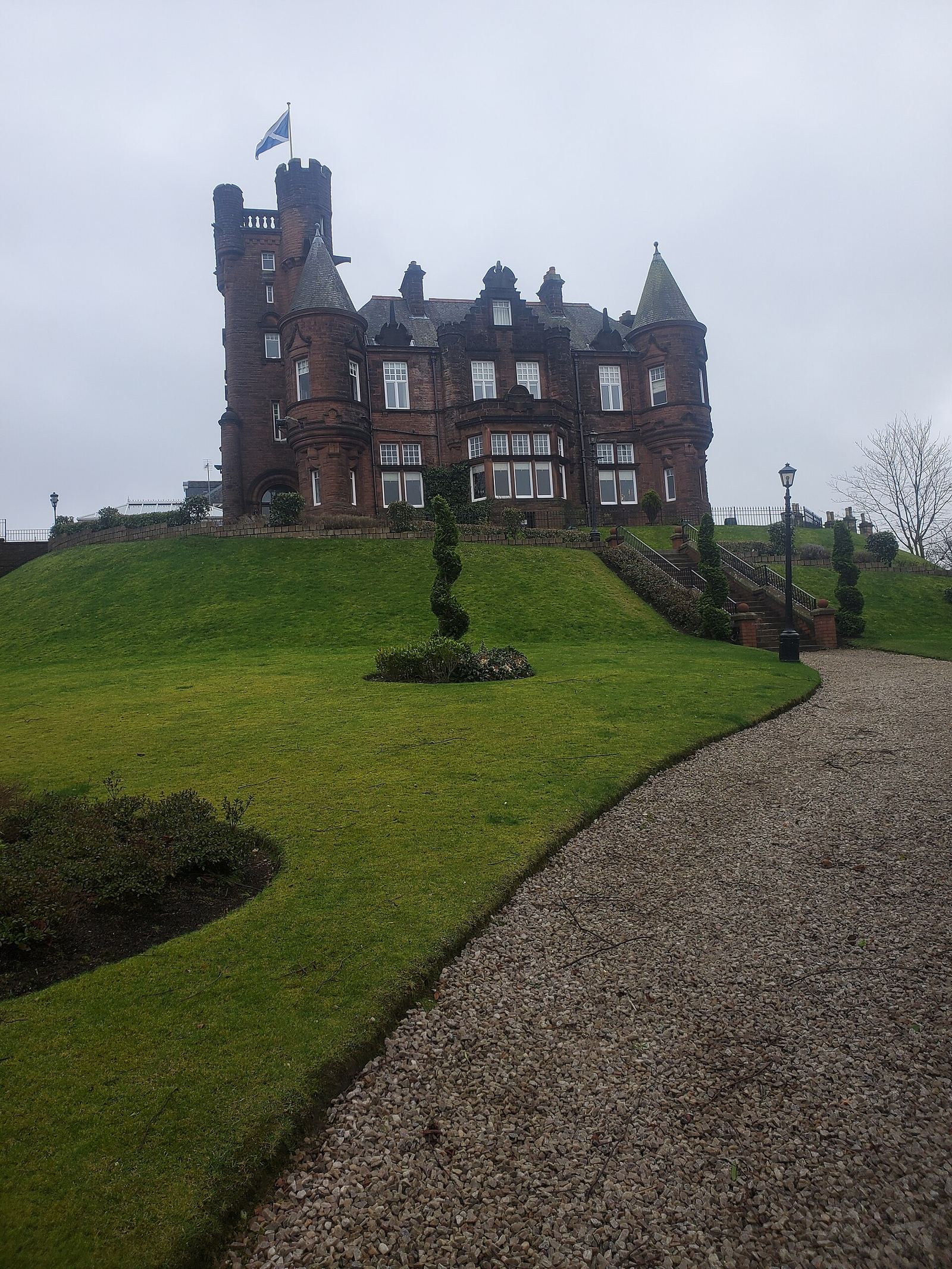

Most of the buildings below are private homes, churches or working buildings. View them from the street.
| Building | Address | Architect | Date | Listing |
|---|---|---|---|---|
| Haggs Castle | On the old Pollok estate; now a private home | Built for Sir John Maxwell; restored by Sir John Stirling-Maxwell | 1585; restored 1899-1900 | Not stated in sources |
| The Knowe | 301 Albert Drive | Alexander Thomson; later additions by J.C. McKellar (1899) | Begun about 1852, built in stages to about 1880 | Listed (HES LB33371) |
| Ellisland | 200 Nithsdale Road | Alexander Thomson | 1871 | Listed (HES LB33450) |
| Castlehill | 202 Nithsdale Road | Alexander Thomson | 1871 | Not stated in sources |
| 84-112 Nithsdale Road | 84-112 Nithsdale Road | Alexander Thomson | 1873 | Not stated in sources |
| St Ninian's Episcopal Church | Albert Drive at Pollokshaws Road | Not stated in sources | 1873 | Category B |
| Pollokshields Free Church (now Nithsdale Lodge) | 614-620 Shields Road | W.G. Rowan of McKissack and Rowan | 1875-79 | Listed (HES LB33482) |
| Pollokshields Parish Church | 274 Albert Drive | Robert Baldie; chancel by H.E. Clifford | 1877-78; chancel 1912-14 | Listed (HES LB33477) |
| Pollokshields Primary School | 241 Albert Drive | David Barclay of H and D Barclay | 1882 | Listed (HES LB33370) |
| Stockwell Free Church (now St Albert's Roman Catholic Church) | 149-153 Albert Drive | John Bennie Wilson | 1886-87 | Category B (1984) |
| Pollokshields Burgh Hall, lodge and park gateway | Maxwell Park | H.E. Clifford; 1935 additions by Thomas Somers | 1888-90 | Category A (upgraded 1993) |
| Ardtornish | 30 Sutherland Avenue | James Miller | 1892-93 | Not stated in sources |
| Balmory | 21 Sherbrooke Avenue | W.J. Anderson | About 1893 | Not stated in sources |
| Sherbrooke St Gilbert's Church | Nithsdale Road | Not stated in sources | Hall 1894, church 1900; rebuilt after 1994 fire | Not stated in sources |
| Tramway (former Coplawhill tram works) | 25 Albert Drive | William Clark, engineer; redeveloped by Zoo Architects | 1894-1912; 1998-2000 | Category B (1990) |
| Terraced houses | Glencairn Drive at Shields Road | Burnet, Boston and Carruthers | 1895 | Not stated in sources |
| Glasgow Laundry and Carpet Beating Works | 100-132 Albert Drive | Not stated in sources | About 1895 | Category B (1984) |
| Rhuadsgeir (now Sherbrooke Castle Hotel) | 11 Sherbrooke Avenue | Thomson and Sandilands | 1895-96 | Category B (1990) |
| Oaklands | 31 Sherbrooke Avenue | J.C. McKellar | 1902 | Category B (HES LB33472) |
| Millar and Lang art publishers | 46-50 Darnley Street | John Gordon, completed with D.B. Dobson | 1901-03 | Listed (HES LB33402) |
| Matheran | 27-29 Sherbrooke Avenue | Burnet, Boston and Carruthers | 1903 | Category B (1990) |
| Pollokshields Library | 30 Leslie Street | Thomas Gilmour, revised by A.B. McDonald (City Architect's Department) | Opened 1907 | Category B (1984) |
| Dunholme | Hamilton Avenue | James Miller | 1909 | Not stated in sources |
| Drumlanrig (alterations) | 32 Newark Drive | J. Gaff Gillespie of Salmon, Son and Gillespie | 1911 and 1915 | Not stated in sources |
| Glasgow Gurdwara | 37 Albert Drive | CRGP | 2013 | Modern building |
Key architects
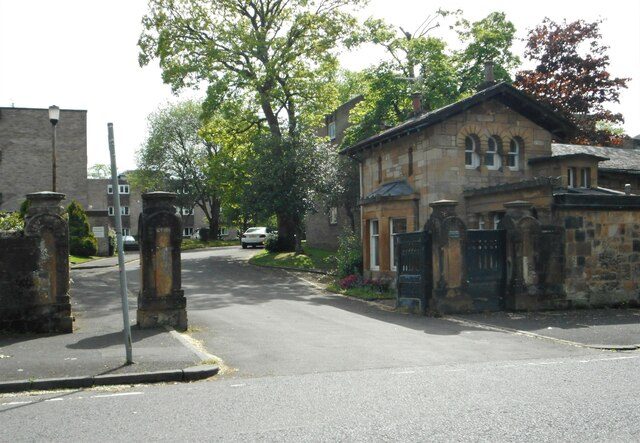
- David Rhind (1801-1883). Edinburgh architect who laid out the original feus in 1849.
- Alexander "Greek" Thomson (1817-1875). Built villas here as well as in Langside, Helensburgh and Bute. He lived next door at Moray Place, Strathbungo, where he died. The Knowe is his earliest surviving villa.
- H.E. Clifford (1852-1932). Born in Trinidad and trained under John Burnet senior. He designed the Burgh Hall, tenements on Fotheringay Road and Terregles Avenue, and many villas, and lived in Pollokshields in the early 1890s.
- James Miller (1860-1947). Later architect of the Central Station hotel extension and the Turnberry Hotel. His Ardtornish villa dates from 1892, the year he set up his own practice.
- Burnet, Boston and Carruthers. The practice behind Matheran and the Glencairn Drive terraces. James Carruthers was the partner associated with Matheran and 39 Sherbrooke Avenue.
- John Bennie Wilson. Designed Stockwell Free Church on Albert Drive in a free Italian Renaissance style. It is now St Albert's Roman Catholic Church.
- W.G. Rowan. Designed the Shields Road Free Church, the Harriet Street tenements (1881) and the parish church communion table (1912).
Notable people
All of the people below are historic figures or public figures whose own biographies link them to Pollokshields.
| Name | Dates | Connection |
|---|---|---|
| Sir John Stirling-Maxwell | 1866-1956 | Gave Maxwell Park, opened the Pollok Estate to the public and co-founded the National Trust for Scotland. |
| John Blair | 1817-1886 | Merchant who commissioned The Knowe, the suburb's earliest surviving villa. |
| The Hamilton family | From 1851 | Early St Andrews Drive residents whose bequest funds Kelvingrove's art purchases, about 80 paintings so far. |
| James Howden | 1832-1913 | Engineer of the forced-draught ship furnace; lived on Princes Street, now McCulloch Street. |
| Hugh Dunsmuir | 1841-1913 | Marine engineer and blockade-runner chief engineer who commissioned Matheran. |
| Dr Robert Pollok | 1856-1909 | Boer War medical officer who commanded the 4th Scottish General Hospital; lived on Shields Road. |
| John Stewart MacArthur | 1857-1920 | Co-developer of the cyanide process for extracting gold; died at his Shields Road home. |
| James Grieve | 1863-1939 | Clerk of works to Sir Robert Lorimer; paid most of the parish church alterations. |
| Sir John Auld MacTaggart | 1867-1956 | Housebuilder who commissioned the villa Kelmscott on Springkell Avenue. |
| William Weir, 1st Viscount Weir | 1877-1959 | Chairman of G and J Weir and Air Secretary in 1918; lived at Douglas House, Glencairn Drive. |
| Jane Haining | 1897-1944 | Lived on Forth Street in 1917-27; died at Auschwitz after staying with her Jewish pupils in Budapest. |
| John MacCormick | 1904-1961 | Born in Pollokshields; nationalist leader of the Scottish Covenant of 1949-51. |
| Hannah Frank | 1908-2008 | Glasgow Jewish artist and sculptor, partly educated at Albert Road Academy. |
| Sheila Ogilvie | 1927-2012 | Local historian, author of Pollokshields Pastiche, and a founder of Pollokshields Heritage. |
| Eric Woolfson | 1945-2009 | Raised in Pollokshields; co-creator of The Alan Parsons Project. |
| Rustie (Russell Whyte) | Born 1983 | Electronic producer from Pollokshields whose album Glass Swords won the Guardian First Album Award. |
Communities and faiths
Pollokshields is among Scotland's most diverse places. In the 2022 Census, 53.5% of people in Pollokshields East were from a minority ethnic group, up from 47.8% in 2001. In Pollokshields West the figure was 39.3%.
South Asian Glasgow
The first generation of South Asian migrants arrived in the 1940s and 1950s, after Partition. Numbers grew in the 1960s and 1970s. Most early arrivals came from Punjab, and after 1947 mostly from what became Pakistan.
Early migrants often worked as cloth pedlars or in building. Many families later ran shops, and some built large wholesale and cash-and-carry firms. Students and NHS recruits came too.
Pollokshields, Woodlands and Govanhill became the main areas of settlement. By 1986 about 16,000 Glaswegians had Indian or Pakistani roots.
Glasgow Women's Library and Pollokshields Development Agency recorded migrant women's stories in the oral-history book She Settles in the Shields.
Places of worship
- Masjid Noor, 79 Forth Street. In use as a mosque since 1979. A new mosque on the site was proposed in 2025.
- Glasgow Gurdwara, 37 Albert Drive. Opened in 2013 next to Tramway, with a prayer hall, langar hall and seven classrooms. It is described as Scotland's first purpose-built gurdwara.
- 32 St Andrew's Drive. A 19th-century villa that served as a gurdwara in the 20th century.
- Pollokshields Parish Church, 274 Albert Drive. Church of Scotland, opened 1878.
- Sherbrooke St Gilbert's, Nithsdale Road. Church of Scotland, rebuilt after a fire in 1994.
- St Albert's. Roman Catholic, in the former Stockwell Free Church of 1886-87 on Albert Drive.
- St Ninian's. Scottish Episcopal, at Albert Drive and Pollokshaws Road, built 1873.
Glasgow's largest Sikh temple, opened in 2016, is on Berkeley Street in Finnieston, not in Pollokshields.
Community organisations
Local groups include Pollokshields Heritage (1992), the Pollokshields Trust and Pollokshields Community Council. The library on Leslie Street keeps books in both Urdu and English.
Hard moments
In March 2004, 15-year-old Kriss Donald was abducted from Kenmure Street and murdered. It was Scotland's first conviction for a racially motivated murder.
On 13 May 2021, the day of Eid al-Fitr, Home Office officers detained two Sikh men on Kenmure Street. Neighbours gathered, and hundreds surrounded the van. After about eight hours police released the men on safety grounds. A documentary, Everybody to Kenmure Street, followed in 2026.
The name
In Gaelic the name is Buthan Phollaig, and in Scots Powkshiels. "Pollok" is generally linked to the Gaelic pollag, a pool.
The "-shields" part comes from the old Shields lands of the Pollok estate, the section Rhind laid out in 1849.
The burgh's arms were never officially registered. They were adapted from the Pollok arms with Sir John Stirling Maxwell's permission. The saltire comes from the Maxwell Earls of Nithsdale, a ring stands for the Eglinton line, and a castle probably stands for Pollok Castle.
Some street names have changed. Princes Street is now McCulloch Street. There is no reliable published source for the origins of most street names.
Stories worth knowing
- Cricket and cup finals. Clydesdale's footballers lost the first Scottish Cup final in 1874. Queen's Park later used Titwood while the second Hampden was finished, and beat Aston Villa 6-1 there.
- Trams and horses. Tramway's first floor once held stables for the horses that pulled Glasgow's trams before electrification in 1901.
- A nine-hour opener. Tramway's first show as an arts venue, in 1988, was Peter Brook's The Mahabharata.
- Instant ancestry. Several grand villas, such as Matheran and Oaklands, have mock tower houses built onto them, a Victorian taste for looking old.
- Lotus chimneys. Ellisland's chimney pots are shaped like lotus flowers, one of Thomson's Egyptian touches.
- Gold from Pollokshields. J.S. MacArthur helped develop the cyanide process, which changed gold mining worldwide.
- Impressionists for Kelvingrove. The Hamilton Bequest, which buys art for Kelvingrove, goes back to a family who moved to St Andrews Drive in 1851.
- The 1882 school tragedy. A playground shelter at the new Albert Drive school collapsed onto about 30 children, and four died. The architect and four tradesmen faced charges but were released.
- The holly motto. The Maxwell motto, "Do good while the holly is green", is carved on the Burgh Hall. Holly also appears in the Millar and Lang building's fittings.
- A park from the big house. Many of Maxwell Park's plants came from Pollok House's gardens, and a bed commemorates plant hunter George Forrest.
- The elephant stone. A barrage balloon was moored in Maxwell Park in the Second World War. A large rock nearby is known locally as the elephant stone.
- A lodge with a long run. Lodge Pollok, a masonic lodge, has met in the Burgh Hall since it opened. Its first two masters gave stained glass.
- Rooftop promenades. In 1877 some houses on Aytoun Road reportedly had flat roofs for walking on.
- Spanish masters. Pollok House, the family seat, holds one of Britain's best Spanish collections, including El Greco, Goya and Murillo.
To see many of these places on foot, follow our heritage walks.
Sources
Checked 13 October 2026.
- Pollokshields, Wikipedia
- Pollokshields, The Glasgow Story
- South Asian Glasgow, The Glasgow Story
- Tenements, The Glasgow Story
- History of Pollokshields, Pollokshields Heritage
- Notable architecture, Pollokshields Heritage
- Notable residents, Pollokshields Heritage
- Heritage trails, Pollokshields Heritage
- Pollokshields Burgh Hall listing, Historic Environment Scotland
- Pollokshields Library listing, Historic Environment Scotland
- Oaklands listing, Historic Environment Scotland
- Matheran, British Listed Buildings
- Tramway, British Listed Buildings
- Sherbrooke Castle Hotel, British Listed Buildings
- 100-132 Albert Drive, British Listed Buildings
- Conservation areas, Glasgow City Council
- Pollokshields Burgh Hall, Wikipedia
- Maxwell Park and Pollokshields Burgh Hall, SGHET
- Haggs Castle, Wikipedia
- Pollok House, Wikipedia
- Sir John Stirling-Maxwell, Wikipedia
- Titwood, Wikipedia
- Tramway, Wikipedia
- Our story, The Hidden Gardens
- Cathcart Circle Lines, Wikipedia
- Pollokshields East station, Wikipedia
- Pollokshields Library, Wikipedia
- The growth of East Pollokshields in 1877, Bygone Bungo
- Alexander Thomson, Wikipedia
- Henry Edward Clifford, Wikipedia
- Jane Haining, Wikipedia
- John MacCormick, Wikipedia
- Eric Woolfson, Wikipedia
- Rustie, Wikipedia
- Pollokshields East profile, Understanding Glasgow
- Pollokshields West profile, Understanding Glasgow
- Glasgow Gurdwara, European Heritage Days
- Pollokshields mosque expansion, Urban Realm
- She Settles in the Shields, Bella Caledonia
- Charrettes and challenges in Pollokshields, BEFS
- Pollokshields regeneration, Scottish Housing News
- Kriss Donald, Wikipedia
- Kenmure Street protests, Wikipedia
- Firework control zones, STV News
- Pollokshields arms, Heraldry of the World
- Pollok, Wikipedia