Pollokshields is best seen on foot. These two walks cover the villa streets of West Pollokshields and the tenement grid of East Pollokshields, with addresses, architects and dates for each stop.
See both routes, stop by stop, on the map of Pollokshields.
Almost every house on these walks is a private home. Stay on the pavement, do not enter gardens or closes, and be considerate with cameras. Churches, mosques and the gurdwara are working places of worship.
The two walks join up. Do them together for a full day, or one at a time. For background on the people and buildings, see our history of Pollokshields.
West villas walk
This walk starts at Maxwell Park station and takes in the Burgh Hall and the grand villas of Sherbrooke Avenue and Nithsdale Road. It shows the garden suburb at its most ambitious.

- Start
- Maxwell Park station, on the Cathcart Circle from Glasgow Central
- Finish
- 614-620 Shields Road, where the East walk can begin
- Time
- About 2 hours at an easy pace, with time to stop and look
- Ground
- Pavements on residential streets, some gentle slopes
- Step-free
- The route itself is on pavements. Check station access with ScotRail before you travel
- Facilities
- Few on the route. Plan food and toilets in advance; see eat and drink
Stops are grouped by street. Use a map app to link them, as the curving streets can be confusing.
Maxwell Park station
Opened on 2 April 1894, when the Cathcart Circle was completed via Shawlands. The station building is Category B listed.
The railway tied the suburb more closely to the city. Trains to Central still take under 10 minutes.
Maxwell Park
Farmland until about 1850, the park was given by Sir John Stirling-Maxwell in 1887 or 1888 and opened in 1890.
Look for the pond, the Hamilton Fountain (given in 1908 by the Hamilton sisters in memory of their brothers) and a bed honouring plant hunter George Forrest. Many plants came from Pollok House's gardens.
In the south-west corner, find the big rock locals call the elephant stone. A wartime barrage balloon was moored nearby.
Pollokshields Burgh Hall
By H.E. Clifford, 1888-90, in dark red Ballochmyle sandstone. Category A listed, together with its lodge and the park gateway.
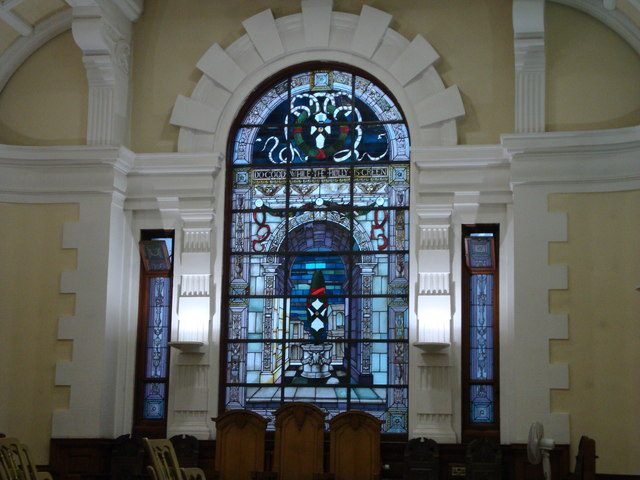
Stained glass inside the Burgh Hall. Photo: David McMumm, CC BY-SA 2.0 Look for the 18 metre tower with its bartizan, the Maxwell arms with lions over the porch, and masonic symbols in the carving. The Maxwell motto, "Do good while the holly is green", is carved on the building.
The hall was the burgh's headquarters for barely a year before Glasgow took over in 1891. A community trust has run it since buying it for one pound in 1986. The two lodges first housed the sanitary inspector and the park gardener.
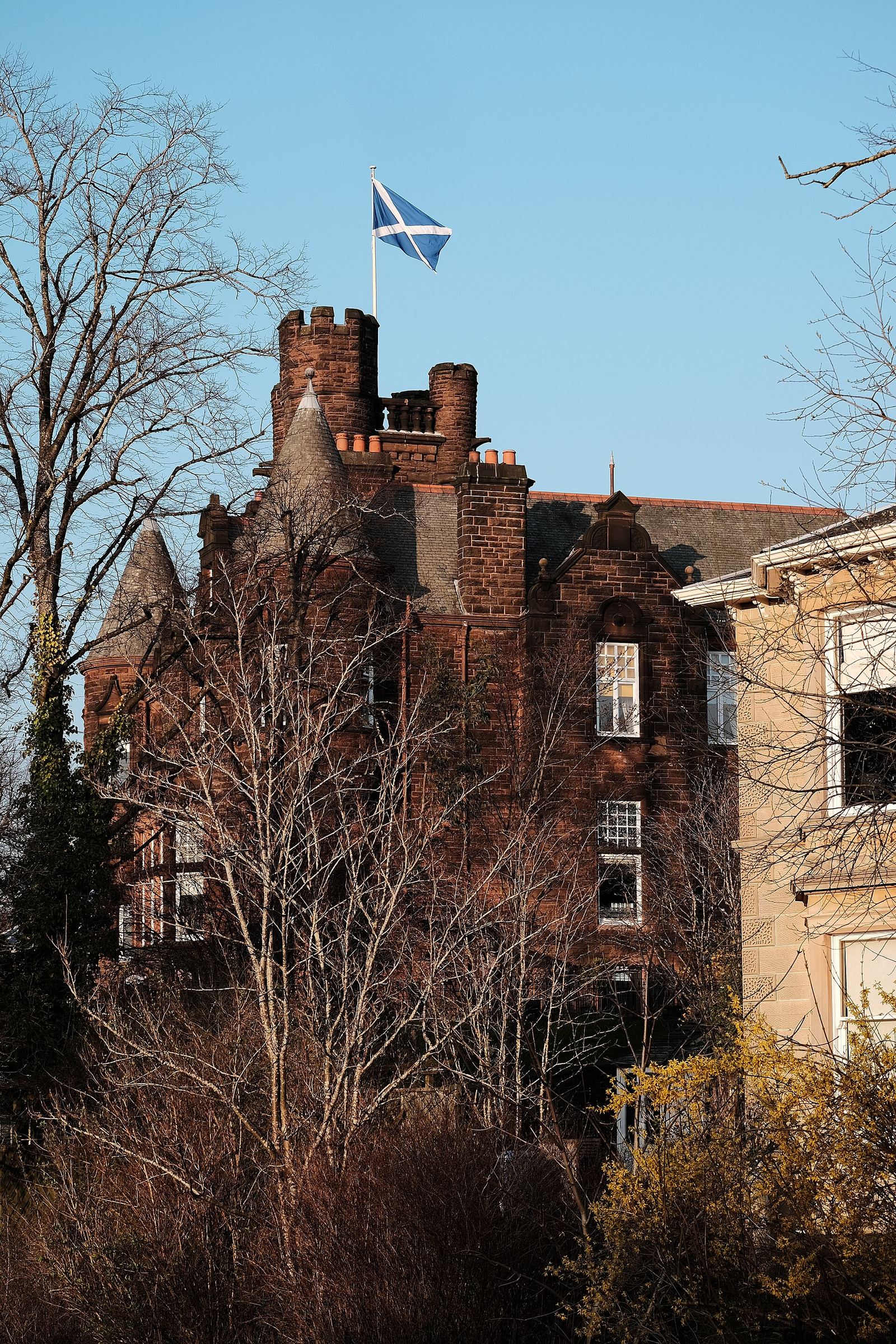
Sherbrooke Castle Hotel
11 Sherbrooke Avenue. Built in 1895-96 as Rhuadsgeir for contractor John Morrison, to designs by Thomson and Sandilands. Category B listed.
Look for the tall thin tower, bartizans and crow-stepped gables in red ashlar. As a hotel, it is one of the few villas here you can go inside.
Balmory
21 Sherbrooke Avenue, by W.J. Anderson, about 1893. A private house: view from the street.
Matheran
27-29 Sherbrooke Avenue. A Scots Baronial villa of 1903 by Burnet, Boston and Carruthers, built for marine engineer Hugh Dunsmuir. Category B listed.
Look for the rock-faced red ashlar, turrets and a dummy tower house, designed to look much older than it is. It was once a school of occupational therapy and became a family home again in 2011.
Oaklands
31 Sherbrooke Avenue, on the corner of Springkell Avenue (105 Springkell Avenue). By J.C. McKellar, 1902. Category B listed.
Another asymmetrical villa with a dummy tower house, this time under red-tiled roofs. Compare it with Matheran next door.
39 Sherbrooke Avenue
Credited to James Carruthers, the partner behind Matheran. A private house.
Springkell Avenue
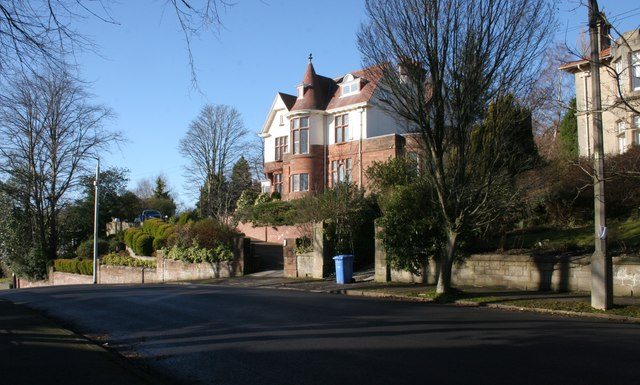
A villa on Springkell Avenue. Photo: Richard Sutcliffe, CC BY-SA 2.0 Housebuilder Sir John Auld MacTaggart commissioned the villa Kelmscott on this street. He claimed to have made Glasgow "bathroom conscious".
Ardtornish
30 Sutherland Avenue. By James Miller, 1892-93, the year he set up his own practice. Miller went on to design the Turnberry Hotel and the Central Station hotel extension.
Drumlanrig
32 Newark Drive. J. Gaff Gillespie of Salmon, Son and Gillespie worked on this house in 1911 and 1915. A private house.
Ellisland and Castlehill
200 and 202 Nithsdale Road, by Alexander "Greek" Thomson, 1871.
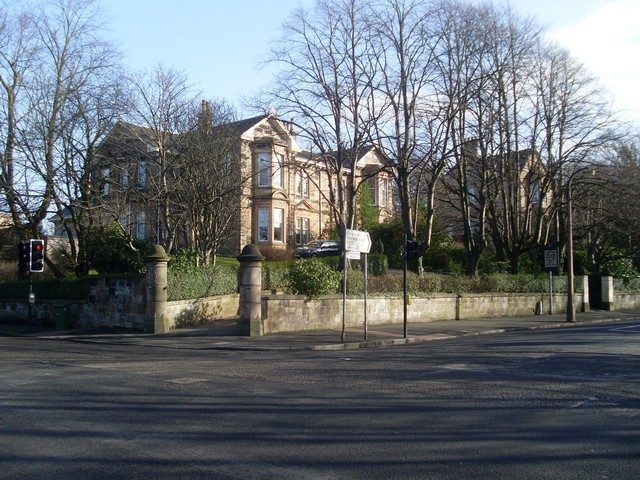
Villas on Nithsdale Road, in the west. Photo: Stephen Sweeney, CC BY-SA 2.0 Ellisland is a single-storey villa, unusually symmetrical for Thomson. Look for the porch of Egyptian columns and the chimney pots shaped like lotus flowers.
Sherbrooke St Gilbert's Church
Nithsdale Road. The hall was finished in 1894 and the church in 1900. It was rebuilt after a major fire in 1994.
84-112 Nithsdale Road
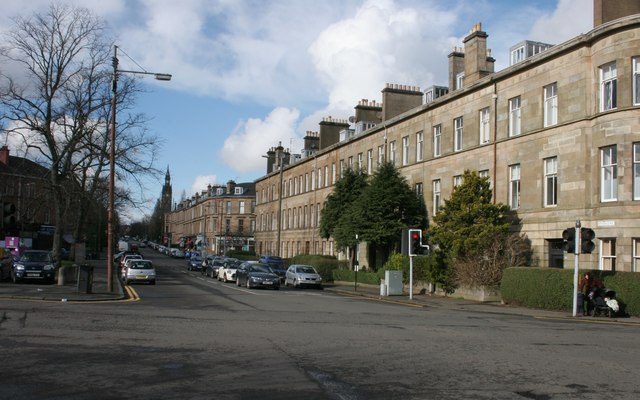
Tenements on Nithsdale Road. Photo: Richard Sutcliffe, CC BY-SA 2.0 A Thomson design of 1873, one of his later works here. He died two years later at Moray Place, Strathbungo, just to the east.
Glencairn Drive and Shields Road terraces
Terraced houses of 1895 by Burnet, Boston and Carruthers. Viscount Weir, Air Secretary in 1918, lived at Douglas House on Glencairn Drive.
Former Pollokshields Free Church
614-620 Shields Road. By W.G. Rowan of McKissack and Rowan, 1875-79, now Nithsdale Lodge.
Look for the tall square corner tower with its domed open lantern and the Ionic porticoes, a close study of Thomson's Greek style. Shields Road marks the old line between villa west and tenement east.
East tenements walk
This walk follows Albert Drive east through the tenement grid, with side trips for wally closes, the library and an Art Nouveau print works. It ends at Tramway, the Hidden Gardens and Pollokshields East station.

- Start
- Shields Road, at the end of the West walk. You can also begin at Maxwell Park station, as the heritage society's audio trail does
- Finish
- Tramway and the Hidden Gardens, 25 Albert Drive, then Pollokshields East station
- Time
- About 2 hours at an easy pace, longer if you visit Tramway or the gardens
- Ground
- Flat city pavements on busy shopping streets
- Step-free
- The Hidden Gardens are fully wheelchair accessible. Pollokshields East station has no step-free access
- Food
- Plenty of cafes, bakeries and restaurants on Albert Drive and Forth Street; see eat and drink
Fotheringay Road tenements
17-57 Fotheringay Road, by H.E. Clifford. These are among the Art Nouveau tenements on the heritage society's trail.
Look at the doorways and stair windows. Do not enter the closes.
Terregles Avenue tenements
Clifford also designed tenements at Shields Road and Terregles Avenue. Flats here built in 1895 were large, with parlour, dining and drawing rooms, a bathroom and a servant's bedroom.
These were upmarket homes, a world away from the image of the one-room Glasgow tenement.
The Knowe
301 Albert Drive, by Alexander "Greek" Thomson. Begun about 1852 for merchant John Blair in what was still open country, and Thomson's earliest surviving villa.
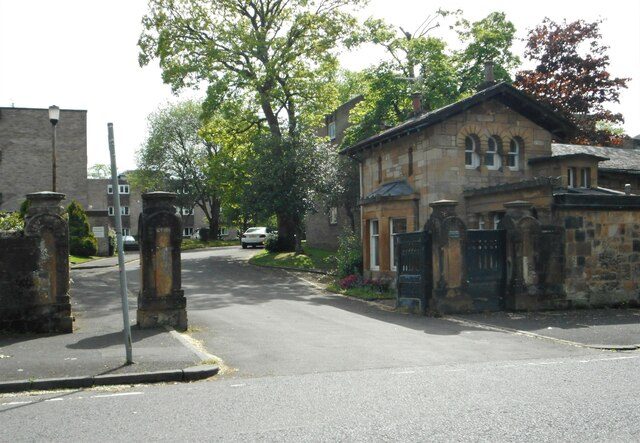
The gateway and lodge of The Knowe on Albert Drive. Photo: Richard Sutcliffe, CC BY-SA 2.0 Look for the tower, broad eaves and round arches of a Romanesque villa. It was built in stages, with additions by J.C. McKellar in 1899. A private house.
Pollokshields Parish Church
274 Albert Drive. By Robert Baldie, opened 1878, at a cost of about 14,000 pounds.
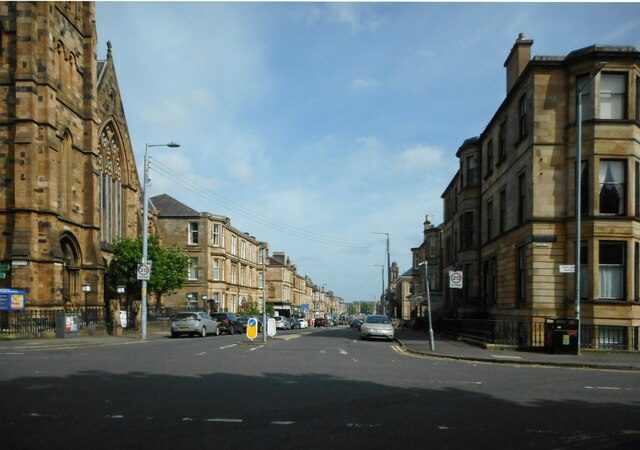
Albert Drive, with the spire of Pollokshields Church on the left. Photo: Richard Sutcliffe, CC BY-SA 2.0 The 180 ft spire with its four-faced clock is the area's tallest landmark, and you enter the church through it. Inside is a 1913 Harrison and Harrison organ in oak cases by H.E. Clifford.
Pollokshields Primary School
241 Albert Drive. By David Barclay of H and D Barclay, 1882, in Scottish Renaissance style with sculpted pilaster panels.
It was renamed several times: Albert Road Academy from 1920, Pollokshields Senior Secondary from 1926 and Pollokshields Primary from 1962. In 1882 a playground shelter here collapsed and four children died.
Kenmure Street
In 1877 this was described as the main north-south road of the new East.
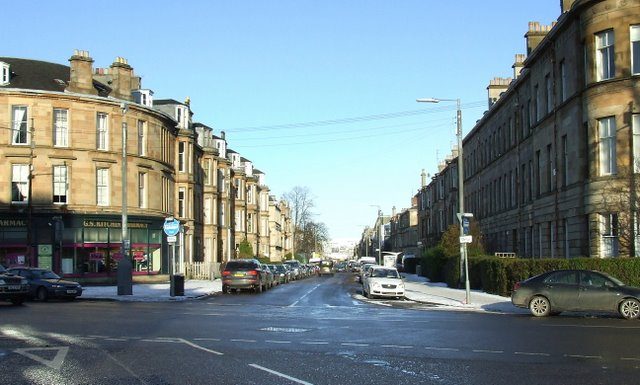
Kenmure Street. Photo: Thomas Nugent, CC BY-SA 2.0 In May 2021 it was the scene of a large neighbourhood protest against a Home Office immigration raid. Please be respectful: people live here.
Pollokshields Library
30 Leslie Street, at the corner of Kenmure Street. Opened on 20 February 1907. Category B listed.
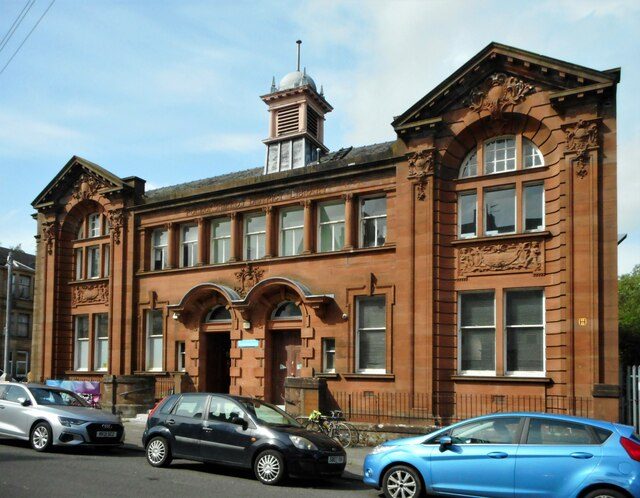
Pollokshields Library on Leslie Street, opened in 1907. Photo: Richard Sutcliffe, CC BY-SA 2.0 Look for the Edwardian Baroque front in polished red ashlar, end pavilions under pediments, a first-floor colonnade and a large ornate roof ventilator. The leaded glass by John C. Hall dates from 1926. The library still lends books in Urdu and English.
Stockwell Free Church
149-153 Albert Drive. John Bennie Wilson won the design in competition in 1886, and the church dates from 1886-87. It is now St Albert's Roman Catholic Church, and Category B listed.
Forth Street and Masjid Noor
Masjid Noor, at 79 Forth Street, has been a mosque since 1979. It is a working mosque; contact it before visiting inside.
Jane Haining, later honoured as Righteous Among the Nations, lived on Forth Street from 1917 to 1927. Forth Street today is lined with bakeries and cafes.
Millar and Lang building
46-50 Darnley Street. Offices for the art publishers Millar and Lang, known for postcards and prints. Begun by John Gordon in 1901 and completed with D.B. Dobson in 1903.
Look up for the figure of Minerva on the three-storey red ashlar front, griffin-shaped rainwater goods and Art Nouveau door furniture. Holly and dolphins feature in the fittings inside.
Glasgow Laundry and Carpet Beating Works
100-132 Albert Drive. Built around 1895 for Thomas Donald's laundry business. Category B listed.
Look for the red ashlar and the pyramid-roofed corner, a handsome working building from the area's industrial edge.
Glasgow Gurdwara
37 Albert Drive. Opened in 2013 on a former derelict site, designed by CRGP. It has a prayer hall, langar hall and seven classrooms.
It is a working place of worship. Contact the gurdwara before visiting inside.
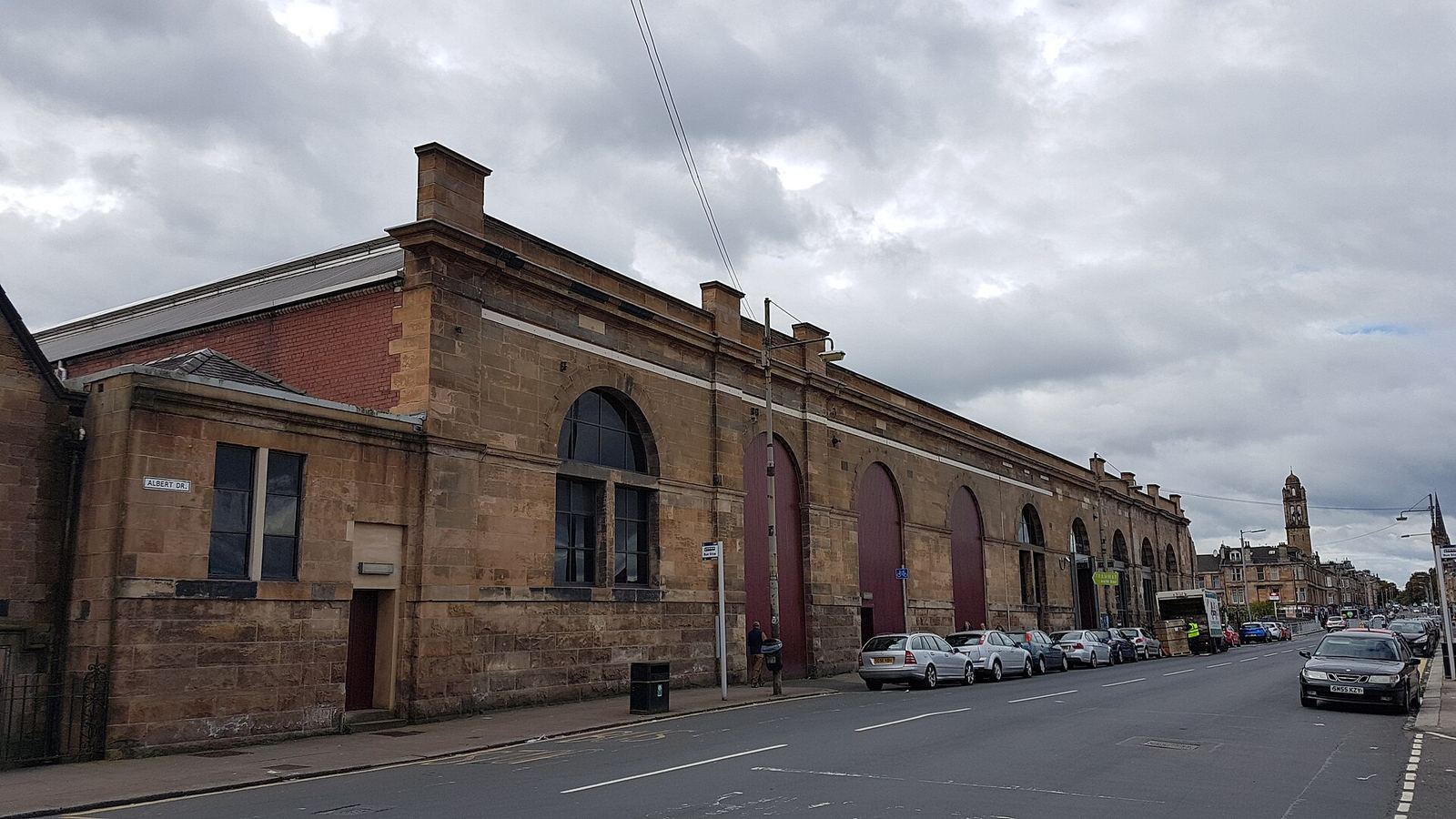
Tramway
25 Albert Drive. Built in stages from 1894 to 1912 by engineer William Clark as the Coplawhill tram depot and works. Category B listed.
Look for the nine round-headed arches along the street. Six were tram entrances, and three were bricked up in 1964. The first floor of the front range held stables for tram horses until 1901.
It was the Museum of Transport from 1964 to 1987 and became an arts venue in 1988. Inside you will find galleries, performance spaces and a cafe bar.
The Hidden Gardens
25a Albert Drive, behind Tramway. Opened on 21 June 2003 by the arts group NVA, on land that was a tree nursery in the early 1800s. It was billed as Scotland's first sanctuary garden dedicated to peace.
A good place to sit at the end of the walk. Closed on Mondays; check opening hours on the gardens' website before you go.
Pollokshields East station
Opened on 1 March 1886 with the Cathcart District Railway. Trains to Glasgow Central take about 4 minutes; see getting here for frequencies. There is no step-free access.
Detour: St Ninian's Scottish Episcopal Church, built in 1873 in early French Gothic style, stands at Albert Drive and Pollokshaws Road. It is Category B listed.
Wally tiles: what to look for
A wally close is a tenement entrance hall and stair lined with glazed tiles. It was a mark of the grander tenements, and Pollokshields Heritage says East Pollokshields has the best wally tiles in Glasgow.
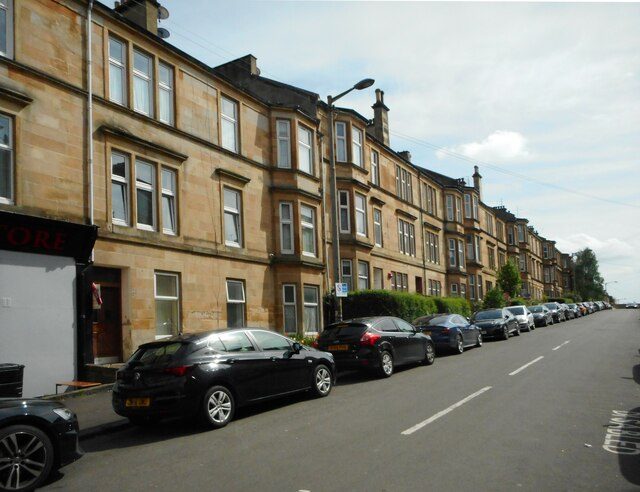
- Look through the door, not past it. Many close doors have glass panels, so the tiles are visible from the pavement.
- Dados and borders. Tiles usually run to about waist or shoulder height, finished with a decorative border.
- Colour. Watch for patterned and coloured tiles in better closes, a sign of how much the builder spent.
- Stair windows. On Art Nouveau tenements, such as Clifford's on Fotheringay Road, look up at the stair windows and doorways too.
Closes are shared private spaces. Do not go in unless a resident invites you, and do not photograph people's doors or windows. Doors Open Days are the best chance to see inside.
Tours, leaflets and Doors Open Days
Pollokshields Heritage, the local conservation and amenity society founded in 1992, publishes the main self-guided trails.
- Printed leaflets. Three trails, Villas, Tenements and Garden Suburb, launched on 3 March 2013.
- Audio trails. Two free Guidigo audio trails. The East trail runs from Maxwell Park station to Tramway and takes in three Art Nouveau tenements, the library, Thomson's earliest surviving villa, wally tiles, churches and mosques.
- Doors Open Days. A digital East Pollokshields trail has run as part of Glasgow's Doors Open Days, starting at Maxwell Park station and ending at Tramway. Check the current year's programme for open buildings and dates.
- Further reading. Local historian Sheila Ogilvie's books Pollokshields Pastiche (1989), Panorama (1990) and In Perspective (2002).
Two leaflets can be downloaded as PDFs: The Tenements of Pollokshields (1.5MB) and Pollokshields: Glasgow's Garden Suburb (6MB). Printed copies may be available at Pollokshields Library, while stocks last.
The society also runs evening heritage talks from November to April at the Fotheringay Centre, 63 Fotheringay Road. They start at 7.30pm and cost £6 on the door. Dates are in what's on.
See the Pollokshields Heritage trails page for downloads and the latest details. For more places to visit nearby, see see and do, and for transport, getting here.
Sources
Checked 13 October 2026.
- Heritage trails, Pollokshields Heritage
- Talks 2026 to 2027, Pollokshields Heritage
- Notable architecture, Pollokshields Heritage
- History of Pollokshields, Pollokshields Heritage
- The Knowe, Pollokshields Heritage
- Ellisland, Pollokshields Heritage
- Pollokshields Church of Scotland, Pollokshields Heritage
- Pollokshields Primary School, Pollokshields Heritage
- Millar and Lang building, Pollokshields Heritage
- Pollokshields Free Church, Pollokshields Heritage
- Pollokshields Burgh Hall listing, Historic Environment Scotland
- Pollokshields Library listing, Historic Environment Scotland
- Oaklands listing, Historic Environment Scotland
- Matheran, British Listed Buildings
- Sherbrooke Castle Hotel, British Listed Buildings
- Tramway, British Listed Buildings
- 100-132 Albert Drive, British Listed Buildings
- Pollokshields Burgh Hall, Wikipedia
- Maxwell Park and Pollokshields Burgh Hall, SGHET
- Architecture, Pollokshields Burgh Hall
- Maxwell Park station, Wikipedia
- Pollokshields East station, Wikipedia
- Pollokshields Library, Wikipedia
- Tramway, Wikipedia
- Our story, The Hidden Gardens
- Glasgow Gurdwara, European Heritage Days
- Tenements, The Glasgow Story
- The growth of East Pollokshields in 1877, Bygone Bungo
- Jane Haining, Wikipedia